
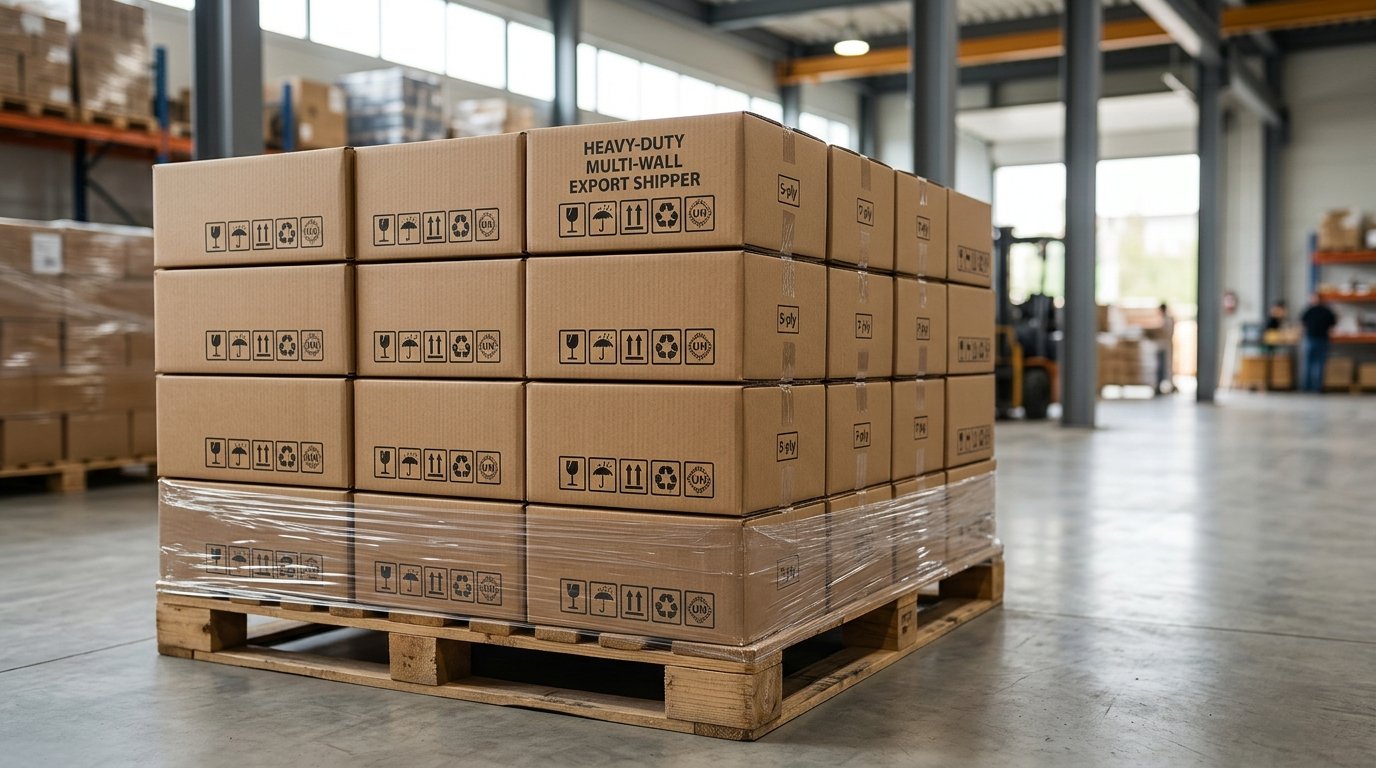
When shipping cargo across international borders, standard domestic shipping cartons inevitably collapse under the extreme physical stresses of multi-modal freight. For manufacturing export houses, automotive component suppliers, engineering equipment builders, and bulk FMCG producers, specifying high-performance heavy duty corrugated boxes for export packaging is the single most critical safeguard against transit losses, wet-damage claims, and costly port rejections.
International shipments endure weeks of oceanic turbulence, continuous vibration on rail heads, severe humidity cycling inside sealed marine shipping containers, and multi-tier warehouse pallet stacking. A domestic 3-ply carton that performs adequately for local distribution will rapidly buckle when subjected to 80% relative humidity and the static compressive load of four stacked pallets. In this comprehensive technical guide to heavy duty corrugated boxes for export packaging, our structural engineering team at Global Packaging explains board compositions, bursting factor (BF) standards, Edge Crush Test (ECT) ratings, and protective barrier treatments essential for seamless global supply chain operations.
Why Export Logistics Demands Heavy Duty Corrugated Packaging
Export logistics introduces mechanical and environmental forces rarely encountered in domestic supply chains. When goods leave an industrial plant in Delhi NCR—whether in Okhla, Mayapuri, Faridabad, or IMT Manesar—they travel via heavy truck to an Inland Container Depot (ICD), undergo gantry crane transfers, get stacked into ocean freight dry containers, and endure weeks of ocean swell, pitch, and roll across marine trade lanes.
The primary hazards that necessitate heavy-duty construction include:
- Dynamic Stacking & Compressive Fatigue: In containerized cargo, boxes are frequently stacked 2 to 3 tiers high on wooden pallets, bearing cumulative loads exceeding 800 to 1,500 kg per pallet base. Over a 30-day ocean voyage, vibration causes compressive creep, causing weak boxes to deform and tip over.
- Extreme Marine Humidity: Relative humidity inside shipping containers regularly hits 90% to 95% during equatorial transit. Standard kraft paper absorbs moisture like a sponge, losing up to 60% of its initial stacking strength unless built with high-bursting factor virgin liners and water-resistant sizing.
- Puncture & Lateral Abrasion: Cargo shifts during maritime navigation or emergency vessel maneuvers generate brutal lateral impact against container side walls and adjacent cargo pallets.
- Port Handling & Forklift Impacts: Multiple transshipment checkpoints mean repeated forklift tines, conveyor impacts, and rough manual unloading at customs bonded warehouses worldwide.
For an in-depth baseline on box anatomy, explore our foundational reference on what is a corrugated box and review regional manufacturing capabilities in our wholesale carton box supplier in Okhla guide.
Wall Construction: Double-Wall (5-Ply) vs Triple-Wall (7-Ply) Heavy Duty Boxes
When selecting heavy duty corrugated boxes for export packaging, the structural debate centers around double-wall (5-ply) versus triple-wall (7-ply) architecture. Single-wall (3-ply) cartons are strictly limited to ultra-light secondary packing or air cargo envelopes where weight minimization overrides stacking loads.
1. Double-Wall (5-Ply) Heavy Duty Cartons
A 5-ply corrugated export box consists of three flat paper liners (outer face, inner center medium, and inside liner) sandwiching two distinct fluted mediums (typically combining a B-flute and a C-flute). This construction provides an exceptional balance between high puncture resistance, printability on the exterior surface, and robust top-to-bottom compression strength. 5-ply cartons are the global export benchmark for products weighing between 20 kg and 60 kg, including garments, precision electronic instruments, processed food exports, and automotive replacement spares.
2. Triple-Wall (7-Ply) Heavy Duty Industrial Cartons
Triple-wall 7-ply cartons represent the pinnacle of paperboard structural engineering. Featuring four flat liners separating three fluted medium cores (often combining A-B-C or A-A-C flute configurations), 7-ply cartons approach the structural rigidity and compression capacity of solid timber or plywood shipping crates—while reducing tare weight by up to 70%. Triple-wall boxes are engineered for heavy industrial machinery, cast iron pumps, electric vehicle batteries, bulk dry chemicals, and oversized export components weighing up to 250 kg to 500 kg.
Technical Specification & Strength Comparison Matrix
Engineers and procurement specialists evaluate export packaging using precise laboratory parameters: Grams per Square Meter (GSM), Bursting Factor (BF), Bursting Strength (BS), and Edge Crush Test (ECT). Below is a direct comparison matrix across standard commercial export grades:
| Engineering Specification | Standard 3-Ply (Domestic/Air) | Heavy Duty 5-Ply (Export Grade) | Industrial 7-Ply (Heavy Machinery) |
|---|---|---|---|
| Wall Construction | Single Wall (2 Liners + 1 Flute) | Double Wall (3 Liners + 2 Flutes) | Triple Wall (4 Liners + 3 Flutes) |
| Paperboard GSM Range | 120 – 180 GSM Liners | 180 – 250 GSM High-BF Liners | 250 – 400 GSM Heavy Virgin Kraft |
| Bursting Factor (BF) | 16 – 20 BF | 24 – 32 BF Virgin Kraft | 32 – 40+ BF High-Tensile Kraft |
| Bursting Strength (BS) | 6.0 – 9.0 kg/cm² | 14.0 – 22.0 kg/cm² | 28.0 – 45.0+ kg/cm² |
| Edge Crush Test (ECT) | 23 – 32 lbs/in (3.5 – 5.6 kN/m) | 44 – 65 lbs/in (7.7 – 11.4 kN/m) | 80 – 120+ lbs/in (14.0 – 21.0 kN/m) |
| Static Load Capacity | Up to 15 kg | 40 kg to 80 kg | 150 kg to 500+ kg |
| Flute Profiles Used | B or C Flute | BC Flute Combination | AAC or ABB Flute Combination |
| Primary Freight Mode | Domestic Courier / Air Express | Full Container Load (FCL) / LCL Ocean | Heavy Ocean Freight / Industrial Breakbulk |
| Timber Replacement Viability | Not Suitable | Replaces lightweight plywood | Direct replacement for heavy timber crates |
To calculate exact packaging budgets for these specifications, check our practical guide on 10 smart ways to reduce packaging costs and compare with retail options in our mailer boxes vs corrugated shipping boxes comparison.
Flute Engineering: Combining B, C, and A Flutes for Superior Resistance
The secret to the high load-bearing capacity of heavy duty corrugated boxes for export packaging lies in mathematical flute geometry. Different flute sizes offer distinct mechanical advantages:
- A-Flute (~4.8 mm height, ~33 flutes/foot): Offers the thickest cushioning cushion and highest vertical column crush resistance. Ideal for absorbing oceanic vertical shock and bearing top-down static warehouse loads.
- C-Flute (~3.6 mm height, ~39 flutes/foot): The premier all-around logistics flute. Offers excellent compression strength, good puncture resistance, and substantial structural elasticity.
- B-Flute (~2.4 mm height, ~47 flutes/foot): Features more flutes per linear foot, providing a flatter, rigid surface that resists punctures, side impacts, and crushing while enabling crisp flexographic brand printing.
In export engineering, combining flutes produces synergistic strength. The widely adopted BC-Flute combination places the compact B-flute on the outer wall for puncture defense and crisp branding, while the deeper C-flute sits on the inner core to absorb impacts and support immense vertical stacking pressure.
Combatting Marine Humidity & Container Rain
One of the most catastrophic risks in ocean freight is container rain. As steel shipping containers traverse shifting climatic zones—such as sailing from the warm Arabian Sea into colder European ports—drastic day-night temperature swings cause trapped air humidity to condense onto the steel ceiling. Droplets rain directly onto the cargo pallets beneath.
To ensure total cargo integrity during 30 to 60 days of ocean voyage, Global Packaging integrates advanced moisture barrier technologies into our export corrugated boxes:
- Water-Resistant Adhesives (WRA): Standard domestic boxes utilize water-soluble cornstarch glues that dissolve under prolonged condensation. Our export grade boxes utilize cross-linked, water-resistant starch adhesives that maintain ply lamination even under continuous damp conditions.
- Hydrophobic Outer Coatings: Applying food-safe aqueous wax emulsion or biodegradable silicone barrier coatings to the exterior kraft liner creates a hydrophobic surface that sheds water droplets and condensation without compromising 100% repulpability.
- Polyethylene (PE) or VCI Lamination: For automotive cast parts, steel fasteners, and precision metallurgy vulnerable to rust, our boxes can be lined with anti-corrosion Volatile Corrosion Inhibitor (VCI) kraft paper, neutralizing oxidation inside the box cavity without requiring oily rust-preventive greases.
- Container Desiccant Synergy: We advise export logistics teams to pair moisture-resistant cartons with high-absorption calcium chloride desiccant poles suspended in the container corrugation recesses.
Palletization, Corner Boards & Sea Container Optimization
Even the strongest 7-ply box will fail if improperly loaded onto export pallets. Maximizing container payload requires precise dimensional harmonization with standard international pallet sizes:
- ISO Standard Pallets: 1200 x 1000 mm (predominant in UK, India, and Southeast Asia) and 1200 x 800 mm (Euro Pallet standard).
- Interlocking vs Column Stacking: While interlocking patterns provide lateral stability during transit, column stacking (stacking boxes directly on top of each other align corner-to-corner) preserves 100% of the carton’s vertical stacking strength. Always favor column stacking reinforced by heavy-duty paper edge protectors.
- Paper Angle Boards / Edge Protectors: Placing rigid compressed cardboard corner protectors along all four vertical pallet corners prevents strapping wire from cutting into box edges and distributes top strapping tension evenly.
- Container Cube Utilization: Sizing box dimensions in modular increments (e.g., 400x300mm or 600x400mm) ensures near-zero overhang or underhang on pallets, filling 20-foot and 40-foot High Cube (HC) containers with maximum volume efficiency, slashing freight per unit.
Explore custom dimensional prototyping in our custom printed corrugated boxes with low MOQ guide.
B2B Procurement Checklist for Indian Exporters
When issuing a Request for Quotation (RFQ) for export packaging, ensure your technical procurement specification sheet mandates the following quality parameters:
- Specify Virgin Kraft Liners: Mandate minimum 180–250 GSM virgin Scandinavian or high-bursting Indian kraft paper for top and bottom liners to prevent tearing and flaking.
- Mandate Bursting Factor (BF): Specify minimum 24 to 32 BF for liners and 20+ BF for fluted mediums.
- Set Strict Edge Crush Test (ECT) Thresholds: For 5-ply cartons, specify ECT $\ge$ 44 to 55 lbs/in; for 7-ply cartons, specify ECT $\ge$ 80 to 110 lbs/in.
- Require Joint Stitching or High-Tack Hot Melt: For heavy cartons carrying over 30 kg, specify heavy-gauge galvanized flat wire stitching (stapling) rather than simple PVA cold glue joints.
- Compliance Markings & International Symbols: Verify that the carton printer includes standard ISO international handling pictograms (Fragile glass icon, This Side Up arrows, Keep Dry umbrella, Recyclable mobius loop) and your exporter customs IEC code.
Why Leading Exporters Choose Global Packaging
At Global Packaging, we have engineered and manufactured heavy-duty industrial and commercial packaging for Indian export enterprises since 2011. Operating from the heart of Delhi NCR, our modern manufacturing facility is equipped with automated corrugation lines, precision die-cutters, and certified testing laboratories.
- Certified Quality & Lab Testing: Every production batch is certified for GSM, moisture percentage, Bursting Factor, and Edge Crush Resistance before dispatch.
- Tailored Moisture & Rust Barrier Treatments: Custom hydrophobic wax, VCI paper lining, and heavy-duty polymer coatings for challenging ocean voyages.
- Flexible Minimum Order Quantities (Low MOQ): Scalable manufacturing runs starting from small pilot batches to multi-container export contracts.
- Rapid Prototype Turnaround: CAD-driven structural sampling delivered within 24 to 48 hours for fitment and drop testing.
- Comprehensive Industrial Cluster Coverage: Same-day and next-day dispatches across Okhla Industrial Area, Mayapuri, Patparganj, Bawana, Narela, Noida Sector 63/65, Udyog Vihar Gurgaon, and IMT Manesar.
Frequently Asked Questions (FAQ)
Request Heavy Duty Export Box Pricing & Samples
Safeguard your global shipments against transit damage, container humidity, and transit claims with certified heavy-duty export packaging engineered by Global Packaging. Contact our packaging engineers today for technical consultation, free sample boxes, and factory-direct wholesale quotations:
- Direct Phone / WhatsApp: +91 85860 28393
- Corporate Email: info@globalpackaging.in
- Factory Consultation & Instant Quote: Request an Instant Packaging Quote Online
- Manufacturing Facility: Delhi NCR, India (Operating Monday through Sunday, 9:00 AM – 8:00 PM IST)
Testing Standards & FAQs for Heavy Duty Corrugated Boxes for Export Packaging
Before dispatching overseas sea or air freight, exporters should verify that their heavy duty corrugated boxes for export packaging meet international transit testing benchmarks such as the International Safe Transit Association (ISTA) vibration, compression, and drop-test protocols. Testing prototypes of heavy duty corrugated boxes for export packaging early prevents container-load crushing and customs damage claims.
- Can I order custom prototypes of heavy duty corrugated boxes for export packaging? Yes. Global Packaging manufactures custom-sized 5-ply and 7-ply heavy duty corrugated boxes for export packaging in Delhi NCR so you can run physical fitment and drop tests before bulk production.
- Which ply is best for heavy duty corrugated boxes for export packaging? Use double-wall (5-ply) cartons for shipments up to 25–30 kg and triple-wall (7-ply) heavy duty corrugated boxes for export packaging of industrial machinery, auto parts, and palletized loads above 35 kg.
- How do heavy duty corrugated boxes for export packaging resist ocean humidity? We engineer heavy duty corrugated boxes for export packaging with virgin kraft liners, high-ECT fluting, and optional moisture-barrier coatings to maintain stacking strength during long sea voyages.
- What is the MOQ for heavy duty corrugated boxes for export packaging in India? We support flexible low-MOQ runs of heavy duty corrugated boxes for export packaging for pilot shipments as well as full-container wholesale volumes with pan-India delivery.
Export Quality Checklist for Heavy Duty Corrugated Boxes for Export Packaging
When sourcing heavy duty corrugated boxes for export packaging from an Indian manufacturer, verify these key specifications before approving bulk production of your heavy duty corrugated boxes for export packaging:
- Edge Crush Test (ECT) & Bursting Strength: Confirm lab-tested ECT and bursting factor certificates for your heavy duty corrugated boxes for export packaging so stacked pallets never buckle inside 20ft or 40ft containers.
- Virgin Kraft Paper Grade: Always specify high-RCT virgin kraft liners for heavy duty corrugated boxes for export packaging rather than recycled fluting when shipping via sea freight.
- Pallet Fit & Weight Distribution: Design heavy duty corrugated boxes for export packaging to match standard Euro or ISO pallet footprints with zero overhang.
- Moisture & Humidity Barrier: Request wax-free water-resistant coatings on heavy duty corrugated boxes for export packaging bound for humid coastal ports.
- Custom Branding & Export Markings: Print handling icons, country-of-origin labels, and barcodes directly onto heavy duty corrugated boxes for export packaging to speed up customs clearance.
- Prototype Sign-Off: Run physical drop and compression tests on sample heavy duty corrugated boxes for export packaging before locking in your wholesale order.
Pingback: 7 Powerful Corrugated Box Wholesale Delhi Benefits
Pingback: Die-Cut Corrugated Boxes Delhi NCR: 3-Ply & 5-Ply Sizing Guide